Introduction
Agile has been widely adopted in organizations to improve their software development process. However, Agile frameworks such as Scrum, Kanban, and Extreme Programming have limitations, and many organizations have found it difficult to scale Agile to larger projects or multiple teams. This is where Nexus Agile Framework comes in. Nexus Agile Framework is a scaled Agile framework that was developed by Scrum.org to help organizations scale Agile development across multiple teams working on large projects. In this blog post, we will explore the Nexus Agile Framework, its principles, practices, and benefits.
What is Nexus Agile Framework?
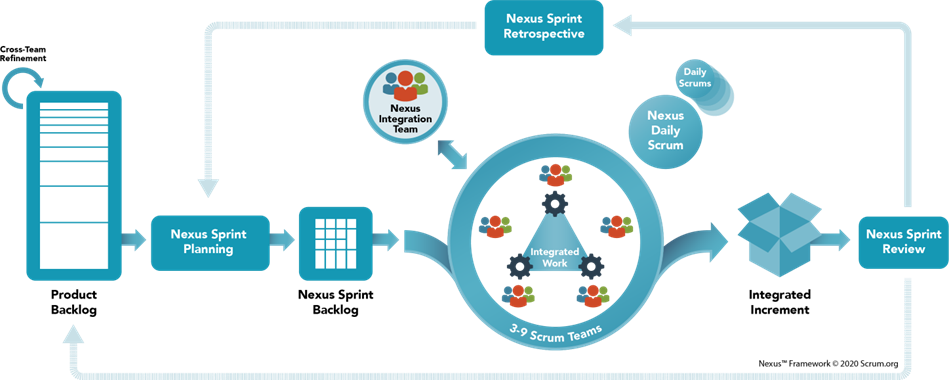
Note : The above graphic for The Nexus Framework from “The Nexus™ Guide” by Scrum.org is licensed under CC BY-SA 4.0
Nexus Agile Framework is a scaled Agile framework that builds upon the Scrum framework. Nexus is designed to help organizations scale Agile development across multiple teams working on large projects. It is based on the following principles:
- Scrum is the foundation: Nexus is built on top of the Scrum framework. It is not a replacement for Scrum but an extension of it.
- Continuous Improvement: Nexus encourages continuous improvement by inspecting and adapting the development process to ensure that the teams are delivering value to the customer.
- Empirical process control: Nexus relies on empirical process control to guide the development process. This means that decisions are based on data and feedback rather than assumptions.
- Transparency: Nexus encourages transparency throughout the development process. This means that all stakeholders have visibility into the progress of the project and can provide feedback.
- Collaboration: Nexus emphasizes collaboration between teams to ensure that the work is integrated and aligned with the overall project goals.
Nexus Framework Roles
The Nexus framework consists of three roles:
- Nexus Integration Team: The Nexus Integration Team is responsible for ensuring that the work of all the teams is integrated and aligned with the overall project goals. The Integration Team is made up of one representative from each Scrum team.
- Scrum Teams: Each Scrum Team follows the Scrum framework and is responsible for delivering a potentially releasable product increment at the end of each sprint.
- Product Owner: The Product Owner is responsible for defining and prioritizing the product backlog items. They work closely with the Scrum Teams to ensure that the product backlog is refined and ready for sprint planning.
Nexus Framework Events
The Nexus framework consists of the following events:
- Nexus Sprint Planning: The Nexus Sprint Planning brings together the Product Owner and the representatives from each Scrum Team to plan the upcoming sprint. The goal is to ensure that all teams are working on the same goal and are aligned with the overall project goals.
- Nexus Sprint Review: The Nexus Sprint Review is a meeting where the representatives from each Scrum Team present their work to the Integration Team and other stakeholders. The goal is to ensure that the work of all the teams is aligned and integrated.
- Nexus Sprint Retrospective: The Nexus Sprint Retrospective is an opportunity for the representatives from each Scrum Team to reflect on the sprint and identify areas of improvement. The goal is to continuously improve the development process.
- Nexus Daily Scrum: The Nexus Daily Scrum is a daily meeting where the representatives from each Scrum Team come together to discuss progress and dependencies. This helps to ensure that all teams are working towards the same goal and that their work is integrated.
Nexus Framework Artifacts
The Nexus framework consists of the following artifacts:
- Nexus Sprint Backlog: The Nexus Sprint Backlog is a prioritized list of items that represent the goals for the Nexus Sprint. The Nexus Integration Team is responsible for creating and maintaining the Nexus Sprint Backlog.
- Product Backlog: The Product Backlog is a prioritized list of features that need to be developed. The Product Owner is responsible for defining and prioritizing the product backlog items.
- Sprint Goal: The Sprint Goal is a shared objective that all the teams are working towards during the Nexus Sprint.
- Nexus Increment: The Nexus Increment is the sum of all the individual team increments. The goal is to deliver a potentially releasable product increment at the end of each Nexus Sprint.
Benefits of Nexus Agile Framework
- Alignment: Nexus helps teams to work towards the same goal and align their efforts with the overall project goals. This helps to ensure that the work of all teams is integrated and aligned with the overall project goals.
- Collaboration: Nexus promotes collaboration between teams to ensure that the work is integrated and aligned with the overall project goals.
- Transparency: Nexus promotes transparency throughout the development process. This means that all stakeholders have visibility into the progress of the project and can provide feedback.
- Scalability: Nexus helps organizations to scale Agile development across multiple teams working on large projects. It builds on the Scrum framework, which is widely adopted and understood by organizations.
Conclusion
The Nexus Agile Framework is a scaled Agile framework that builds upon the Scrum framework. It is designed to help organizations scale Agile development across multiple teams working on large projects. Nexus promotes alignment, collaboration, transparency, and scalability. It is based on the principles of Scrum and emphasizes continuous improvement and empirical process control. Nexus helps organizations
When several Scrum Teams together create an integrated increment, Nexus is the exoskeleton that rests on the teams. Nexus is consistent with scrum, and its parts will look familiar to those who have worked on scrum projects before.