Introduction
Spotify, one of the leading music streaming platforms in the world, has become synonymous with the Agile framework. The company has successfully implemented and scaled Agile practices to deliver innovative products and services to its users. In this blog post, we will explore the Spotify Agile Framework and how it has helped the company achieve its goals.
What is the Spotify Agile Framework?
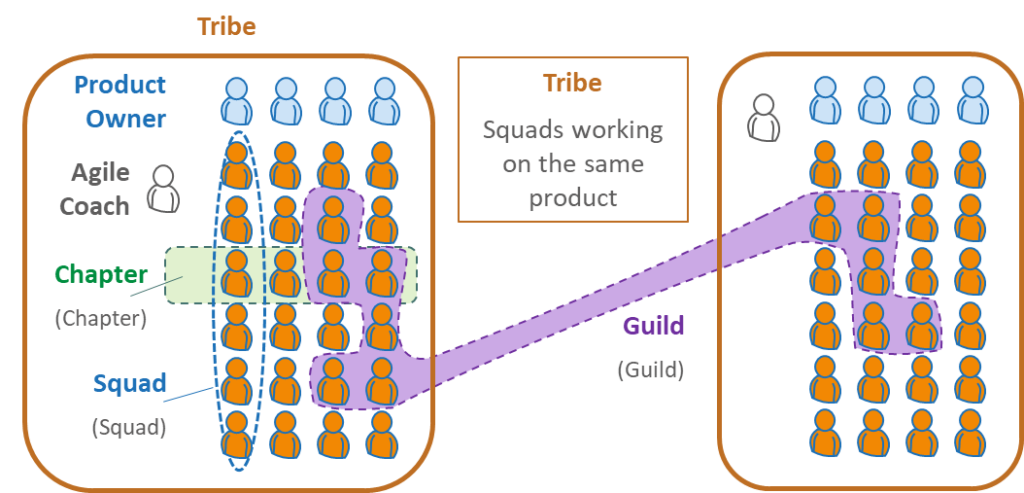
Note : The above graphic for “The Spotify model: By squads, tribes, chapters and guilds” by itedas is licensed under CC BY-SA 4.0
The Spotify Agile Framework is a methodology developed by the music streaming giant to help teams work efficiently and collaboratively. It is a combination of different Agile practices that have been adapted to fit the needs of the organization.
The framework is based on Agile principles such as continuous delivery, customer collaboration, and iterative development. It emphasizes the importance of autonomy, mastery, and purpose for teams to thrive. The Spotify Agile Framework is perfect for organizations that are looking to scale agile practices across multiple teams and departments.
Agile at Spotify
Spotify’s adoption of Agile methodologies began in 2012 when the company’s engineering department grew too fast, leading to a communication breakdown and slower development processes. Spotify’s management team decided to adopt Agile methodologies to improve communication, collaboration, and speed.
The company started with a small, cross-functional team of engineers and product managers who used Scrum as their Agile framework. It then added the concept of squads, tribes, guilds, and chapters to create the Spotify Agile Framework.
Squads
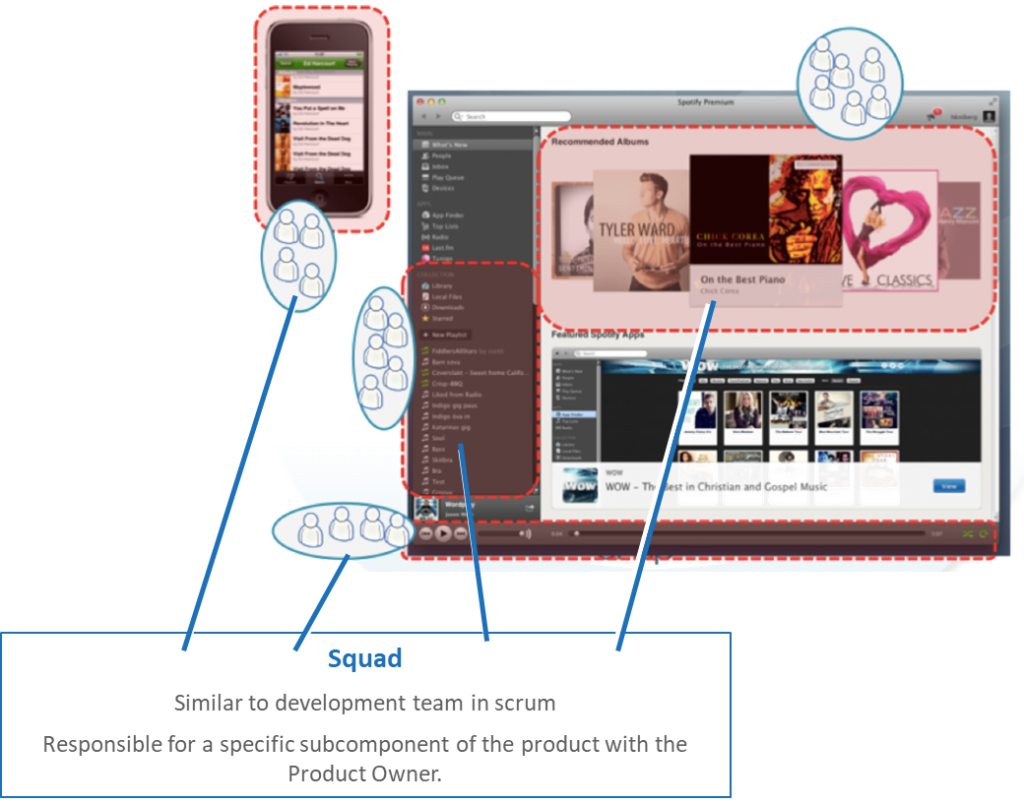
Note : The above graphic for “The Spotify model: By squads, tribes, chapters and guilds” by itedas is licensed under CC BY-SA 4.0
Squads are self-organizing, cross-functional teams that create products and services. They have a clear mission statement and work towards a common goal. Members of a squad have different skills and expertise, which they use to deliver value to their users.
Each squad has a product owner, who is responsible for defining the product vision, prioritizing the backlog, and providing feedback to the team. The squad also has a Scrum master, who facilitates the team’s Agile processes, removes impediments, and coaches the team on Agile practices.
Tribes
Tribes are collections of squads that work on related products or services. They have a shared mission statement and collaborate to achieve common goals. Tribes are led by a tribe lead, who is responsible for ensuring alignment, coordination, and communication between squads.
Guilds
Guilds are informal communities of people with shared interests or skills. They are not part of the Spotify hierarchy but exist to share knowledge, best practices, and ideas among members. Guilds organize regular meetups, workshops, and training sessions to help members grow and develop their skills.
Chapters
Chapters are groups of people within a squad who share the same role or skillset. They can be from different squads but work together to improve their skills, contribute to the community, and solve common problems. Chapters help to promote cross-functional collaboration, cultivate expertise, and provide mentorship and learning opportunities.
Spotify’s Agile Practices
Spotify’s Agile Framework is built upon several Agile practices that ensure its success. Here are some of the key practices that the company follows:
Continuous Deployment
Continuous deployment is a practice that involves continuously delivering new features and updates to the product. At Spotify, squads are expected to deploy code changes to production several times a day. This practice ensures that new features are delivered quickly, and users get to experience them sooner.
Lean Startup
The Lean Startup methodology is a customer-centric approach to product development. At Spotify, squads are encouraged to validate their assumptions by testing their products with users. Lean Startup principles enable Spotify to identify what works and what doesn’t work, leading to faster iterations and improved product quality.
Agile Coaching
Spotify provides Agile coaching to all its employees. The company has a dedicated team of Agile coaches who work with Squads, Tribes, Chapters, and Guilds to improve their Agile practices. Agile coaching helps teams to identify areas for improvement, gain new perspectives, and implement best practices.
Agile Metrics
Spotify uses Agile metrics to measure the effectiveness and progress of squads. While individual teams are autonomous, they must align themselves with the overall company goals. Agile metrics measure things like team velocity, throughput, and the satisfaction of the product owner and users.
Spotify’s Agile Framework at Scale
Spotify’s Agile Framework has been successful in supporting the company’s growth and scaling its operations. The framework has been adopted by other companies, and it has been the subject of many case studies and books.
As the company grew, it faced challenges in scaling its Agile practices. To address the scaling issue, Spotify introduced the “Spotify Model,” a framework that breaks down the core Agile practices into separate layers that work together.
The “Spotify Model” is composed of three layers: Agile Squads, Agile Tribes, and Agile Chapters. Squads still retain their autonomy but work collaboratively within tribes to share knowledge, resources, and goals. Chapters provide a support system for squads to grow their skills and abilities.
Conclusion
Spotify’s Agile Framework is an excellent example of how Agile practices can be successfully implemented and scaled. The framework emphasizes autonomy, mastery, and purpose while promoting collaboration, communication, and continuous learning. Spotify’s Agile practices have enabled
YouTube videos about the Spotify model:
•Part 1: https://youtu.be/Yvfz4HGtoPc
Part 2: https://youtu.be/Ddpm4IObKeA
Spotify White Paper : Scaling Agile @ Spotify with Tribes, Squads, Chapters & Guilds
https://blog.crisp.se/wp-content/uploads/2012/11/SpotifyScaling.pdf
How to Cite Creative Commons Images
https://guides.library.msstate.edu/c.php?g=862896&p=6266442
This is a tool to help you build attributions. As you fill out the form, the app automatically generates the attribution for you.
Best practices for attributionUse this link to read about best practices on how to cite Creative Commons images. You can use CC-licensed materials as long as you follow the license conditions. One condition of all CC licenses is attribution.
How to Find CC License VersionThis page identifies the principal improvements to the Creative Commons license suite since the publication of the first licenses (version 1.0) in December 2002, through the current version 4.0, published November 2013.
Marking your work with a CC licenseYou have chosen a CC license for your work. Now how do you go about letting the world know?